💥 BREAKING: Blue Origin New Glenn rocket explodes at Cape Canaveral — FAA investigating 🌕 NASA outlines $1 billion Moon Base investment · Artemis III crew June 9 🛸 FAA requires Starship investigation before next flight 🧊 NASA: "Make Pluto a Planet Again" — papers in preparation 🔭 Roman Space Telescope: September 2026 launch · Construction complete 💥 BREAKING: Blue Origin New Glenn rocket explodes at Cape Canaveral — FAA investigating 🌕 NASA outlines $1 billion Moon Base investment · Artemis III crew June 9 🛸 FAA requires Starship investigation before next flight 🧊 NASA: "Make Pluto a Planet Again" — papers in preparation 🔭 Roman Space Telescope: September 2026 launch · Construction complete
G-Type Main-Sequence Star · Solar Cycle 25 Declining · Live Solar Monitor
☀️

THE SUN

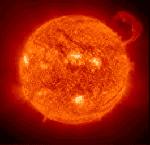
Our home star — a seething ball of plasma 1.3 million times the volume of Earth, powering all life and weather on our planet from 93 million miles away.

⚡ Last flare: C1.1 · 18:36 UTC today ☀️ Activity: Low 🔴 AR4446: Beta-gamma 📅 Solar Cycle 25 — declining phase
Advertisement · 728×90
Google AdSense Leaderboard
Space science audience · $25–40 CPM
Live Solar Data — May 30, 2026

CURRENT SOLAR ACTIVITY

C1.1
Last Flare
18:36 UTC · Normal
🌡️
LOW
Solar Activity
No current flares
🧲
Kp 1
Geomagnetic
Quiet — no storm
🔴
AR4446
Key Sunspot
β-γ · Most complex
💨
~380
Solar Wind
km/s · Calm
🌀
C25
Solar Cycle
Max: Oct 2024
Solar News — May 2026

SOLAR NEWS

All news →
☀️ May 30, 2026 — Today
Sun Quiet Today — Last Flare C1.1 · AR4446 Evolves to Beta-Gamma — Most Complex Region on Disk
After a busy week, the Sun is resting. AR4446 has gained a gamma component — beta-gamma magnetic complexity makes it capable of stronger flares. Space weather forecasters are monitoring closely. A coronal hole stream arrived earlier this week, briefly unsettling Earth's magnetic field before settling back to quiet.
EarthSky · NOAA Space Weather · May 30, 2026
☀️ May 26–27, 2026
AR4446 Fires C9.7 — Just Below M-Class · GOES-19 Captures Dramatic Far-Side Eruptions
AR4446 pushed conditions tantalizingly close to moderate levels with a C9.7 flare (nearly M-class, which is 10× more powerful). NOAA's GOES-19 satellite filmed dramatic far-side eruptions in inverted imagery. Solar wind from a coronal hole briefly elevated geomagnetic conditions toward G1 minor storm levels, enhancing auroras at high latitudes.
EarthSky · NOAA GOES-19 · May 27, 2026
☀️ May 10, 2026
M5.7 Solar Flare + CME — Northern Lights Visible Across High Latitudes This Week
A powerful M5.7 solar flare erupted on May 10, launching a coronal mass ejection toward Earth. The flare triggered a radio blackout over the Atlantic Ocean. The resulting geomagnetic storm produced auroras visible in northern Canada, Alaska, Scandinavia, and northern Europe — not as extreme as May 2024's G5 event, but still spectacular.
Daily Galaxy · Space.com · May 12, 2026
☀️ February 2–4, 2026
Six X-Class Solar Flares in Four Days — NASA SDO Composites 2026's Most Powerful Solar Burst
The Sun fired 6 X-class flares — the most powerful category — in just four days. NASA's Solar Dynamics Observatory captured all six in extreme ultraviolet light, compositing them into a single striking image. X-class flares can disrupt GPS, radio communications, and satellite operations globally.
NASA SVS / SDO · February 5, 2026
About Our Star

WHAT IS THE SUN?

The Sun is a G-type main-sequence star — a massive ball of plasma held together by its own gravity and powered by nuclear fusion in its core. It contains 99.86% of all the mass in the Solar System and its gravity keeps every planet, asteroid, and comet in orbit around it.

At its core, the Sun fuses 600 million tonnes of hydrogen into helium every second. The energy takes up to 100,000 years to travel from the core to the surface — then just 8 minutes 20 seconds to reach Earth. The Sun is ~4.6 billion years old with roughly 5 billion years of fuel remaining.

KEY FACTS

Type
G-type main-sequence star
Age
4.6 Billion Years
Diameter
1,391,400 km
Mass
333,000× Earth's mass
Surface temperature
5,500°C
Core temperature
15 million °C
Distance from Earth
149.6 million km (1 AU)
Light travel to Earth
8 min 20 sec
Composition
73% Hydrogen · 25% Helium
Solar cycle
~11 years
Gravity (surface)
274 m/s² (28× Earth)
Remaining lifespan
~5 Billion Years

LAYERS OF THE SUN

🔥
Core — 15,000,000°C
Nuclear fusion powerhouse. 600M tonnes of hydrogen → helium every second. Photons take up to 100,000 years to escape.
☢️
Radiative Zone — 7,000,000°C → 2,000,000°C
Energy moves outward as photons, endlessly absorbed and re-emitted. Extremely dense and opaque — light barely moves.
🌀
Convection Zone — 2,000,000°C → 5,500°C
Plasma too cool to radiate rises in massive convection cells. This turbulent zone generates the Sun's magnetic dynamo — the source of sunspots and flares.
☀️
Photosphere (Surface) — ~5,500°C
The visible "surface." Sunspots appear here as dark, cooler patches (~3,500°C) where magnetic fields suppress convection. Solar flares also originate here.
🌅
Chromosphere — 4,000°C–20,000°C
Reddish layer visible during solar eclipses. Solar prominences — arching plasma loops — extend from here. Temperature mysteriously increases moving outward from the photosphere.
👑
Corona — 1,000,000°C–3,000,000°C
The Sun's outer atmosphere — the pearly white halo visible during total solar eclipses. Far hotter than the surface — the unsolved "coronal heating problem." Solar wind flows outward from here at 400–800 km/s, reaching Earth in 1–4 days.
Advertisement · 970×250
Google AdSense Billboard
$25–40 CPM

SOLAR FLARE CLASSES

A
Weakest
Background. No Earth effects.
B
Minor
Rarely any impact.
C
Common ← NOW
Minor radio blackouts possible.
M
Moderate
Radio blackouts, auroras at high lat.
X
Extreme
Planet-wide blackouts, power grid risk.
⚠️
NEVER look at the Sun without proper solar filters!
Even a brief glance through a telescope, binoculars, or with the naked eye can cause permanent, irreversible blindness. Regular sunglasses, CDs, and smoked glass are NOT safe. Always use ISO 12312-2 certified solar filters or a dedicated solar telescope.
🔭
Safe Solar Viewing Methods
Solar eclipse glasses (ISO 12312-2) — safe for naked-eye viewing including the August 12, 2026 total solar eclipse (Spain & Iceland). H-alpha solar telescope (Lunt, Coronado) reveals prominences, flares, and chromospheric detail invisible in white light. Baader AstroSolar film covers any telescope for white-light sunspot viewing. Projection method — project through any telescope onto a white card, no eyepiece filter needed.

ACTIVE SOLAR MISSIONS

NASA
Parker Solar Probe
Fastest spacecraft ever built — has entered the Sun's corona, the first to "touch" the Sun. Getting within 8.5 solar radii.
● Active
ESA · NASA
Solar Orbiter
First images of the Sun's polar regions. Studies the solar wind and discovers tiny "campfire" flares near the surface.
● Active
NASA
Solar Dynamics Observatory
Full-disk image of the Sun every 12 seconds in 10 wavelengths. Source of most viral solar photos. Running since 2010.
● Active
NOAA · NASA
GOES-19
Geostationary satellite monitoring solar X-ray output in real time. Instant flare detection and space weather alerts.
● Active
ESA · NASA
SOHO
30 years of solar monitoring. Has discovered 4,000+ comets. LASCO coronagraphs track CMEs in real time. Since 1995.
● Active (30 yrs)
NOAA
DSCOVR
At the L1 Lagrange point, providing 15–60 minutes advance warning for incoming CMEs — the Earth's early warning system.
● Active
☀️
Total Solar Eclipse — August 12, 2026
The path of totality sweeps across northern Spain and Iceland. During totality the corona is visible to the naked eye — the only time you can safely look directly at the Sun. One of Europe's best eclipses in decades. Plan your trip →
🐕
SpaceDawg
● Online — exploring the cosmos

The Solar System planets at www.solarsystem.com
Earth in the Solar System Mars Jupiter Saturn Uranus Pluto

Search the Galaxy:

SolarSystem.com

    www.solarsystem.com